Artificial intelligence is advancing at a speed few people imagined possible.
Machines can now write articles, generate artwork, analyze complex data, create software code, and even hold conversations that feel surprisingly human.
Every new breakthrough raises the same question :
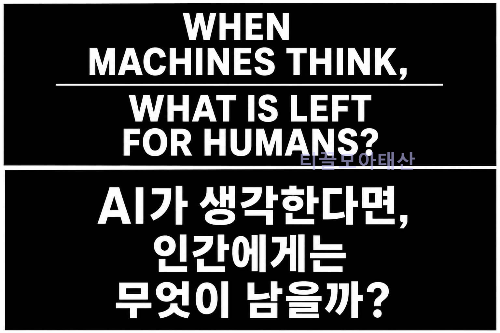
When machines think, what is left for humans?
At first glance, the question sounds unsettling.
If AI can perform intellectual tasks once considered uniquely human, where do people fit into the future?
But perhaps this question leads us to a deeper truth about what it means to be human.
The Age of Intelligent Machines
For centuries, intelligence was viewed as humanity's greatest advantage.
Our ability to reason, calculate, solve problems, and create knowledge helped us build civilizations and transform the world.
Today, AI systems are becoming increasingly capable in many of these areas.
They can :
- Analyze vast amounts of information
- Recognize patterns
- Generate content
- Assist decision-making
- Automate complex workflows
As machines become better at thinking, many people worry that human value may diminish.
However, history suggests something different.
Technology rarely eliminates human value.
Instead, it changes where that value comes from.
Intelligence Alone Is No Longer Enough
For generations, education focused heavily on acquiring knowledge and technical expertise.
Knowledge remains important.
But in a world where information is instantly accessible and AI can process it within seconds, knowledge alone is no longer a competitive advantage.
The future may belong less to those who simply know more and more to those who can :
- Interpret information
- Connect ideas
- Ask better questions
- Make meaningful judgments
The ability to think critically becomes more valuable when machines can generate answers.
Human Experience Cannot Be Downloaded
AI learns from data.
Humans learn from life.
This distinction matters.
Every person is shaped by :
- Childhood memories
- Personal struggles
- Relationships
- Failures
- Successes
- Cultural experiences
These experiences create perspectives that cannot be replicated through algorithms alone.
Two people may face the same challenge and reach completely different conclusions because of their unique life journeys.
That individuality remains one of humanity's greatest strengths.
Creativity Beyond Computation
AI can create impressive content.
It can generate images, music, stories, and designs within seconds.
Yet creativity is more than production.
Human creativity often emerges from :
- Curiosity
- Emotion
- Imagination
- Personal meaning
Some of history's greatest works were inspired by love, loss, hope, fear, and ambition.
AI can imitate patterns.
Humans create meaning.
And meaning is what gives creativity its lasting impact.
Empathy Becomes More Valuable
As technology becomes increasingly intelligent, emotional intelligence may become one of the most valuable human skills.
Empathy allows us to :
- Build trust
- Understand others
- Lead teams
- Resolve conflicts
- Strengthen communities
Businesses may automate processes.
But relationships remain fundamentally human.
People want to be understood, not simply analyzed.
The ability to connect emotionally may become a defining advantage in the AI era.
The New Competitive Advantage : Adaptability
If AI teaches us one lesson, it is that change is accelerating.
Industries evolve rapidly.
Job roles transform.
New technologies emerge constantly.
The people who thrive will not necessarily be the smartest or the most experienced.
Instead, success may belong to those who can :
- Learn continuously
- Adapt quickly
- Stay curious
- Embrace uncertainty
Adaptability is becoming one of the most future-proof skills available.
Purpose Cannot Be Automated
Machines can improve efficiency.
They can optimize processes.
They can generate solutions.
But they cannot determine what gives life meaning.
Humans seek purpose.
We ask questions like :
- Why does this matter?
- What kind of future do we want?
- How can we contribute?
These questions move beyond data and logic.
They belong to the human search for meaning.
And that search remains uniquely ours.
Working With AI Instead of Competing Against It
Many discussions frame AI as a competitor.
But the future may not be about humans versus machines.
Instead, it may be about humans working alongside machines.
The most successful individuals will likely be those who know how to use AI as a tool.
AI can amplify :
- Productivity
- Creativity
- Learning
- Innovation
The combination of human judgment and machine capability may be far more powerful than either alone.
Final Thoughts
When machines think, it is natural to wonder what remains for humans.
The answer may be more encouraging than many expect.
As AI becomes better at processing information, uniquely human qualities become even more important.
Our creativity.
Our empathy.
Our adaptability.
Our experiences.
Our purpose.
The future may not belong to machines alone.
It may belong to those who understand that technology changes tools, but humanity defines meaning.
And in a world where machines can think, being human may become our greatest advantage.
'글로벌 관심사_영문 버전' 카테고리의 다른 글
| What Makes Us Human in the Age of Artificial Intelligence (0) | 2026.06.05 |
|---|---|
| What AI Teaches Us About the Future of Human Work (0) | 2026.05.12 |
| How to Stay Relevant in an AI-Driven World (0) | 2026.04.21 |
| The Future of Jobs Is Not About Skills, but Adaptability (0) | 2026.03.24 |
| Work in the Age of AI : Adapt or Fall Behind (0) | 2026.03.13 |
| Are We Ready for the World AI Is Creating? (0) | 2026.03.05 |
| The Hidden Cost of AI Convenience (0) | 2026.02.17 |
| Why the AI Age Feels Exciting and Terrifying at the Same Time (0) | 2026.02.08 |